
People
Daniel Toroitich arap Moi – The “Professor of Politics” from Nakuru
Daniel Toroitich arap Moi (1924–2020) was Kenya's second president and served from 1978 to 2002. Born in Baringo, he became deeply associated with Nakuru through State House Nakuru, his Kabarak home and the educational institutions he established in the region. Kabarak University, Moi High School – Kabarak and other institutions remain part of his educational legacy. His story in Nakuru also includes the moving history of Mercy Njeri, whose school was renamed in her memory following her death in 1985. Moi's legacy remains contested, with supporters remembering his emphasis on education and stability and critics highlighting the authoritarianism and political repression of his era. He was buried at Kabarak in 2020, leaving his life and legacy permanently connected to Nakuru.
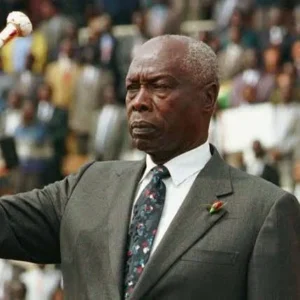
Daniel Toroitich arap Moi was born on 2 September 1924 in Sacho, Baringo County. He became Kenya’s second president in 1978, following the death of Jomo Kenyatta, and remained in office until 2002.
Although Moi was born in Baringo and spent much of his working life in Nairobi, Nakuru became closely associated with his life, politics and legacy. His home at Kabarak, about 20 kilometres from Nakuru City, became his best-known base outside Nairobi and, later, his retirement home.
For much of his presidency, State House Nakuru was also an important venue for his meetings with political leaders, community representatives, religious leaders and ordinary citizens. His regular presence in the region made Nakuru an important part of Kenya’s political landscape during the Moi era.
Education
Education was one of the most visible parts of Moi’s legacy in Nakuru.
At Kabarak, he established Moi High School – Kabarak, which developed into one of Kenya’s prominent secondary schools. He later established Kabarak University, a Christian university, in 2000. The university identifies Moi as its founder and first Chancellor.
Another important institution associated with his era is the Rift Valley Institute of Science and Technology, now known as the Rift Valley National Polytechnic, along the Nakuru–Njoro road. The institution became part of the region’s technical and vocational education landscape.
These institutions remain part of Nakuru’s educational story long after Moi’s presidency.
Mercy Njeri
One of the more personal stories associated with Moi in Nakuru concerns Mercy Njeri, a pupil at what was then Kiamunyi Primary School.
During a visit to the school in 1985, Moi was informed that the young girl needed urgent treatment for a serious heart condition. He helped finance her treatment in the United Kingdom. Mercy unfortunately died after undergoing surgery.
Following her death, the school was renamed Mercy Njeri Primary School. Her name later became associated with other places in the area, including Mercy Njeri Secondary School and Mercy Njeri Shopping Centre.
It is a small but significant story in Nakuru’s history: the name of a child who died young became part of the landscape of the community in which she lived.
Housing and the growth of Nakuru
Moi’s presidency also coincided with significant growth in Nakuru’s population and urban infrastructure. Moi Flats, among the city’s better-known residential developments, formed part of the wider expansion of urban housing during this period.
His influence was not limited to projects carrying his name. Government institutions, roads, housing and public services expanded as Nakuru grew into one of Kenya’s major urban centres.
Kabarak
Perhaps nowhere is Moi’s connection with Nakuru more visible than at Kabarak.
During his presidency, the estate was a private home as well as a place where Moi received visitors. After he left office in 2002, Kabarak became his permanent base.
Politicians continued to visit him there, as did religious leaders, community representatives and people seeking his advice. Over time, Kabarak became inseparable from the public image of Moi in retirement.
His family also maintained substantial agricultural interests in the region, further tying his personal life to Nakuru and the surrounding countryside.
A complicated legacy
Moi’s place in Nakuru’s history cannot be separated from the wider debate about his 24 years in power.
His supporters remember his emphasis on education, national unity, discipline and stability. His government introduced programmes such as the Nyayo milk scheme and oversaw major public investments during a period of rapid national growth.
His critics, however, point to authoritarian government, political repression, patronage and corruption during his presidency.
Both sides are part of the historical record. Gicinga should preserve that complexity rather than turn his story into either a tribute or a condemnation.
His final years
After retiring from the presidency in 2002, Moi continued to live at Kabarak. He remained a prominent figure in Kenyan public life and was frequently consulted by politicians and community leaders.
Moi died at The Nairobi Hospital on 4 February 2020, aged 95. He was later buried at his Kabarak home in Nakuru County with full military honours.
His death marked the end of a political career that had lasted more than five decades and closed one of the longest chapters in Kenya’s post-independence history.
SOURCES:
- The Mercy Njeri Historical Transformation: The Kenya Times feature on historical transformations
- Moi’s Nakuru Affection and Land Holdings: Nation Media Group: Why Moi fell in love with Nakuru
- The Polytechnic Foundation: Rift Valley National Polytechnic History Portal
- Demise and Burial Honours: BBC News Africa – Daniel arap Moi Obituary
- Educational Foundations: Moi High School Kabarak Reference Profile & Kabarak University Official History
Conversation