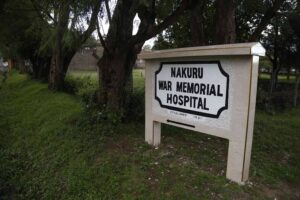
Nakuru War Memorial Hospital is one of Kenya’s oldest surviving healthcare institutions and one of Nakuru’s most historically significant landmarks. Established in 1922 as a memorial to those who served in the First World War, the hospital has provided medical services to residents of Nakuru and the wider Rift Valley for more than a century.
Situated on approximately 25 acres in the leafy Milimani Estate, immediately adjacent to State House Nakuru and the Nakuru Provincial General Hospital (PGH) Annex, the hospital occupies one of the most strategically important parcels of land in the city.
For decades, Nakuru War Memorial Hospital earned a reputation as one of the Rift Valley’s leading private hospitals, offering specialist medical services and attracting patients from across Kenya. Its history reflects the broader evolution of healthcare in Kenya—from colonial segregation, through independence, to modern devolution.
Today, however, the hospital remains closed following a prolonged legal dispute over ownership, lease renewal, and management of the property.
The origins of the hospital lie in the aftermath of the First World War (1914–1918).
During the war, thousands of African porters, soldiers, and European servicemen participated in the East African Campaign. Following the conflict, memorial hospitals were established in several parts of British East Africa to commemorate those who had died while also providing medical services to the growing settler population.
Nakuru War Memorial Hospital officially opened in 1922 under the management of the Nakuru War Memorial Hospital Trust.
The colonial government granted the Trust a 99-year lease over approximately 25 acres of land overlooking Nakuru town.
Unlike government hospitals, the institution operated as a charitable trust with a board comprising prominent community members and senior colonial officials.
Historically, the Board included representatives such as:
This governance model reflected the hospital’s public charitable character.
During the colonial period, the hospital primarily served the European settler community living throughout the White Highlands.
Like many colonial institutions, healthcare access reflected the era’s racial inequalities.
Over time, however, the hospital expanded its services and gradually began treating Africans, Asians and other communities as Nakuru evolved into one of Kenya’s principal urban centres.
Kenya’s independence in 1963 transformed both the hospital and the country’s healthcare system.
Although the War Memorial Hospital Trust continued managing the institution, the hospital increasingly became an important regional referral facility serving patients from across the Rift Valley.
Its location beside State House Nakuru further enhanced its importance.
Throughout the presidencies of Jomo Kenyatta, Daniel arap Moi, Mwai Kibaki, and Uhuru Kenyatta, the hospital remained among Nakuru’s best-known medical institutions.
One of the most significant developments in the hospital’s history occurred during the early post-independence years.
Part of the hospital compound eventually became home to what is today known as the PGH Annex, expanding public healthcare capacity in Nakuru.
For decades, public and private healthcare facilities operated side by side within the same broader property.
This unique arrangement made the site one of Kenya’s most unusual healthcare complexes.
The original 99-year lease, granted in 1922, expired in April 2021.
This marked the beginning of one of the most significant public land disputes in Nakuru’s modern history.
The County Government of Nakuru argued that the land should revert to public ownership upon expiry of the lease to facilitate expansion of healthcare services, including the proposed development of a Level 6 referral hospital.
The hospital’s management maintained that the lease had been lawfully renewed through the relevant land administration processes.
These competing positions led to multiple court cases.
The dispute escalated dramatically in late 2023 and early 2024.
On 27 October 2023, Nakuru County repossessed the property following the lease dispute.
Subsequently, on 23 January 2024, the hospital ceased operations.
Since then:
The closure significantly affected healthcare provision in Nakuru, particularly for patients requiring specialist private treatment.
The ownership and management of the hospital remain the subject of ongoing litigation.
Various courts have issued rulings concerning management of the property and the reopening of medical services.
Separately, criminal investigations have examined the processing of documents relating to the disputed lease renewal. These matters remain before the courts, and legal proceedings continue.
Because these cases have not been finally determined, the issues surrounding alleged irregularities remain matters for judicial resolution.